


For companies – large and small
Companies play a crucial role in the transition towards a more sustainable future. Whether you run a small business or represent a larger corporation, there is now an opportunity to take concrete responsibility for plastic’s impact on the environment.
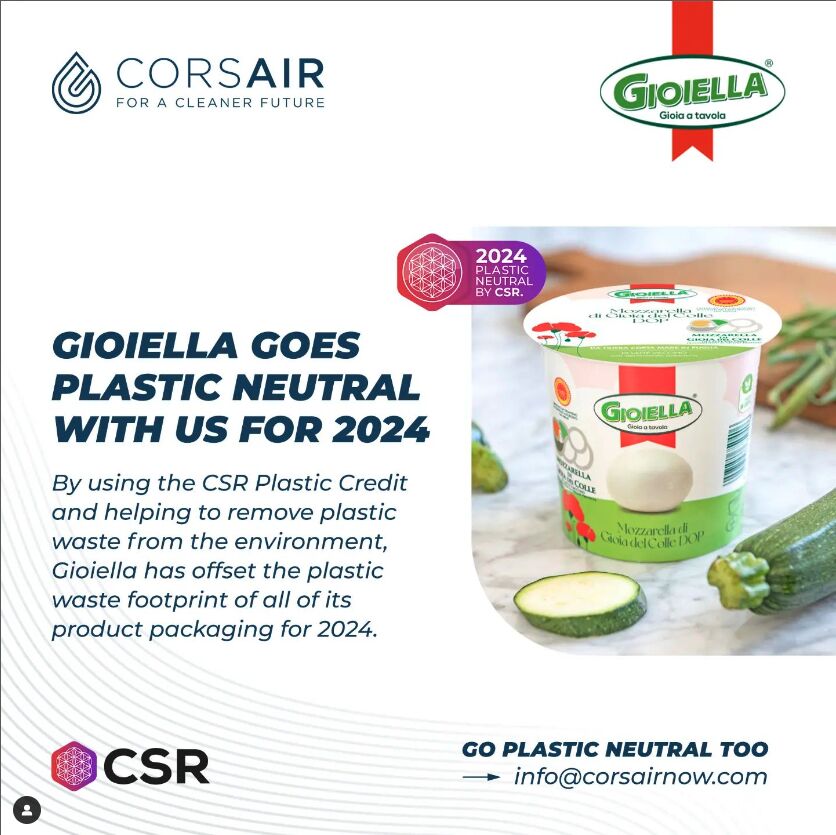
Gioella, in the picture above, is an example of a company that has the CSR logo on its product packaging.
Contact us
This is the entrance for companies that want to work with plastic credits, plastic neutrality, or other sustainable choices.
We help both small and large companies find the right setup and take the step from thought to action – in a simple and correct way.
Regardless of whether you want to offset your plastic footprint, work preventively for future requirements, or explore more opportunities, we guide you all the way and adapt the solution to your company.
The different options:
The demands for sustainability are increasing – from customers, partners, and in line with upcoming regulations. For plastic-producing companies, it is often about legislation and responsibility in the value chain. For other companies, it may be about goodwill, brand positioning, and showing that they take environmental responsibility – even without producing plastic themselves.
Plastic credits – a flexible tool
By purchasing plastic credits, a company can offset its plastic footprint and contribute to removing plastic from nature. The plastic credits always belong to the company and can be used in different ways depending on needs and strategy.
For example, a company can:
offset its actual plastic footprint
work proactively for future requirements
strengthen its brand through visible environmental responsibility
use plastic credits in its sustainability communication
Plastic neutrality
For companies that want to go all the way, there is the option to retire plastic credits and thus become plastic neutral. When credits are retired, the company can receive a certificate or diploma showing that the plastic footprint has been neutralized. This can be used in external communication, on websites, in marketing, or on products.
At the same time, it is important to know that retirement is never mandatory. Many companies choose to only retire the amount that corresponds to their plastic footprint – and keep the remaining plastic credits as part of their long-term sustainability work.
More than plastic credits
In addition to plastic neutrality packages, there is also the opportunity for companies to get more deeply involved, for example through share ownership and long-term participation in solutions linked to plastic recycling and circular economy, in collaboration with Corsair Group International.
In short:
Companies can – on their own terms – take responsibility, contribute to measurable environmental benefits, and at the same time be better equipped for the future. How far you want to go is up to you.
🎥 Episode 19: Corsair’s oil market, regulations and opportunities
(5:10 minutes)
- Pyrolysis oil can be used for fuel or new plastic production
- The EU requires at least 30% recycled content in new plastic
- The regulations apply in full from January 1, 2025
- Demand for ISCC-certified pyrolysis oil is approximately 100 billion liters
- Petrochemical quality is valued at around USD 1 per liter
- Only plastic-to-plastic counts as real recycling
Transcription
Corsair’s oil market, regulations and opportunities
The pyrolysis oil that Corsair produces can be used in two different ways. Either it can be refined into fuels such as gasoline, diesel, and jet fuel, or – more importantly – used as a raw material in the manufacture of new plastic products.
When Corsair started, the original target market was the fuel industry. In that business model, the price level for the oil was approximately 50 cents per liter.
The real breakthrough for the industry came in 2021, when the European Union introduced new regulations requiring companies that produce plastic in Europe, or import plastic into Europe, to use at least 30 percent recycled raw materials in new plastic products. The regulations were introduced in 2021 and came into full force on January 1, 2025.
This change has completely reshaped the chemical recycling industry. Today, there is a market demand for approximately 100 billion liters of ISCC-certified pyrolysis oil that meets the extremely high quality requirements of petrochemicals.
This is crucial for two reasons. Firstly, the market price for pyrolysis oil approved for petrochemical use is approximately 1 US dollar per liter. Secondly, only oil used to make new plastic is classified as real recycling according to the EU and the UN.
Corsair anticipated these regulations well in advance. For two years, we worked purposefully to develop both our process and our product to reach the right quality level. Today, Corsair’s pyrolysis oil is considered one of the best on the market.
This means that a standardized, stand-alone Corsair plant, which can produce up to 10 million liters of pyrolysis oil per year from approximately 12 million kilos of plastic waste, today has a very strong and financially attractive business model.
What distinguishes Corsair from many other players in the pyrolysis oil industry is that our oil can actually be used in petrochemicals. Many other producers still sell their oil to the fuel industry.
The difference is crucial. Pyrolysis oil used as fuel is not counted as recycling according to the EU’s and UN’s definitions, because the oil is then burned. Only when pyrolysis oil from plastic waste is used to make new plastic can it be classified as recycling.
This implies both a clear economic advantage and a very important environmental advantage. By focusing entirely on plastic-to-plastic solutions, Corsair is positioning itself at the center of a rapidly growing, tightly regulated, and global market.
A natural next step:
You don’t need to have all the answers from the start.
An initial conversation is enough to see what is possible and what suits your company.
Get in touch, and we’ll take the next step together.